Mastering Hardware Telemetry, Neural Hashing, and Behavioral Siloing for Tier-1 Social Ecosystems.
Protect your commercially essential Social Media Accounts with best practise digital identity verification protocols.
Updated Daily
The Fallacy of the One-Click Solution
“In the 2026 digital landscape, ‘effortless’ is a forensic signal. If a software or service promises to anonymize you with a single click, it is creating a Uniform Digital Footprint that is mathematically transparent to Global Trust Engines.
Automated ‘Anti-Detect’ shortcuts and one-click scripts generate a predictable telemetry profile that triggers Retrospective Re-evaluation flags across Tier-1 ecosystems. True Identity Resilience cannot be found in a software subscription; it is an architectural discipline.
Protocol 2026 is not a ‘tool’—it is a comprehensive manual of human-centric mimicry and hardware isolation. We do not provide a shortcut; we provide the Sovereign Handbook for professional users who’s prime asset is their digital identity. If you are looking for an effortless ‘hack’ that the algorithm has already mapped and neutralized, this handbook is not for you. If you require a professional-grade, link-proof infrastructure that survives the trillion-dollar heuristics of tomorrow, welcome to the clean start.”

The Architecture of Identity Resilience
Flipping the Zero-Trust model
Protocol 2026 is “operational.” It protects your commercial assets (ad accounts, business managers) from the poorly configured trust engines of the platforms themselves.
In the hyper-accelerated digital landscape of 2026, the traditional concept of “online security” has been rendered obsolete. For the professional media buyer, digital architect, and high-stakes entrepreneur, an online presence is no longer a mere collection of accounts; it is a complex, multi-dimensional commercial asset. However, this asset is under constant siege by Global Trust Engines—sophisticated, trillion-dollar AI heuristics designed to verify, categorize, and, if necessary, terminate digital identities with clinical precision.
The purpose of Protocol 2026 is to bridge the widening gap between legacy privacy tactics and the modern reality of Identity Forensics. Our framework is built upon a single, uncompromising objective: to satisfy every security factor required by Tier-1 social ecosystems to ensure the absolute longevity and sovereignty of your digital identity.
The New Perimeter: Identity as Infrastructure
We have entered an era where “Identity is the New Perimeter.” The defensive walls of SM ecosystems no longer stop at your password or even your 2FA. They now extend into the very marrow of your hardware and the involuntary rhythms of your behavior.
Protocol 2026 provides the blueprint for building a High-Trust Identity Resilience Framework. We move beyond the surface-level “hacks” of the past, focusing instead on the deep technical integration required to survive Retrospective Re-evaluation. If your digital architecture is not insulated from the hardware layer up, your commercial assets remain perpetually vulnerable to Identity Linkage—the silent “toxic” connection to legacy restricted footprints that can trigger platform-wide bans in milliseconds.
The Four Pillars of Resilience
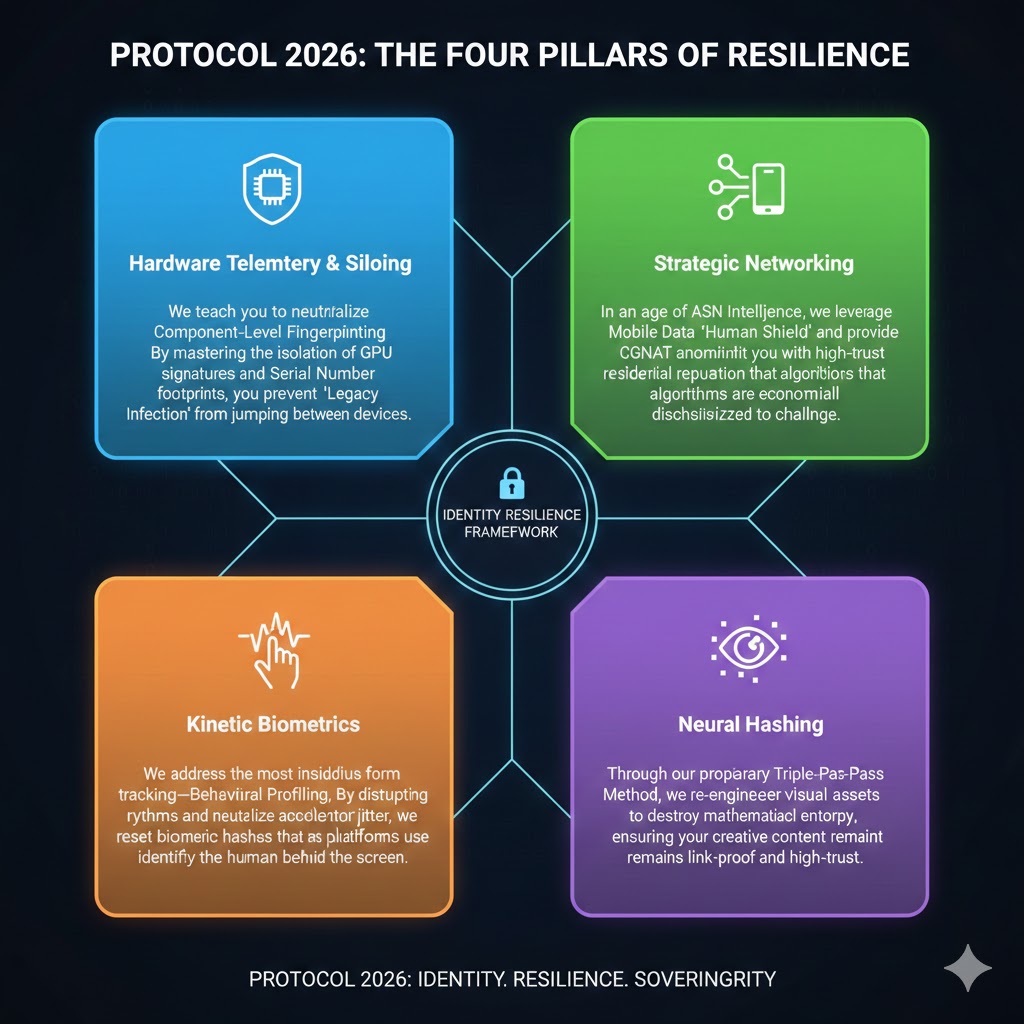
To ensure sustained operational performance, our framework operationalizes four critical pillars of modern identity defense:
-
Hardware Telemetry & Siloing: We teach you to neutralize Component-Level Fingerprinting. By mastering the isolation of GPU signatures and Serial Number footprints, you prevent “Legacy Infection” from jumping between devices.
-
Strategic Networking: In an age of ASN Intelligence, we leverage the Mobile Data “Human Shield” and CGNAT anonymity to provide you with a high-trust residential reputation that algorithms are economically disincentivized to challenge.
-
Kinetic Biometrics: We address the most insidious form of tracking—Behavioral Profiling. By disrupting typing rhythms and neutralizing accelerometer jitter, we reset the biometric hashes that platforms use to identify the human behind the screen.
-
Neural Hashing: Through our proprietary Triple-Pass Sanitization Method, we re-engineer visual assets to destroy mathematical entropy, ensuring your creative content remains link-proof and high-trust.
Your Path to Digital Sovereignty
The goal of this site is not just to help you “bypass” a system, but to help you become a high-value resident of it. By following our 14-Day Nurture Schedule and implementing Consumer Mimicry Protocols, you transition from a “Recidivist Risk” to an “Established Resident.”
Protocol 2026 is the industry-standard manual for those who refuse to let their commercial future be dictated by a legacy footprint. This is the era of Identity, Resilience, and Sovereignty. Welcome to the clean start.
In the digital landscape of 2026, your online presence is no longer defined by a simple login. It is a multi-dimensional, synthesized construct evaluated in real-time by trillion-dollar Global Trust Engines. For professionals managing complex digital assets, the greatest threat to operational longevity is Identity Linkage—the silent accumulation of metadata that connects disparate profiles to legacy restricted footprints.
Welcome to Protocol 2026. This is not a collection of “tricks” or “hacks.” It is a comprehensive High-Trust Identity Resilience Framework Handbook designed for the modern era of neural hashing, kinetic biometrics, and hardware-level telemetry auditing.
Is Your Digital Identity “Toxic”?
Evaluate your current setup against the 2026 Global Trust Heuristics.
1. Hardware History: What is the origin of the device you use for account management?
-
A) Brand new, purchased retail with cash.
-
B) Used/Refurbished from a reputable dealer.
-
C) A device previously used for personal social media or restricted accounts.
-
D) A virtual machine (VM) or cloud-based emulator.
2. Network Signature: How do you connect to your primary commercial assets?
-
A) Dedicated 5G Mobile Hotspot (CGNAT).
-
B) High-end Residential Proxy (Static).
-
C) Standard Home/Office Wi-Fi.
-
D) Commercial VPN or Data Center IP.
3. Behavioral Patterns: How do you typically interact with the platform interface?
-
A) Slow, “messy” navigation with varied dwell times and voice-to-text.
-
B) Direct navigation to Ads Manager/Business Suite only.
-
C) High-speed, repetitive clicks and rapid-fire browser tab switching.
-
D) Automated scripts or “Anti-Detect” browser automation tools.
4. Visual Asset Integrity: How do you prepare your ad creatives before uploading?
-
A) Full “Triple-Pass” re-engineering (Screenshot + Crop + Noise Injection).
-
B) Basic metadata wiping (EXIF removal).
-
C) Slight color/filter adjustments to existing restricted assets.
-
D) Direct upload of the original file.
5. Operational Velocity: What is your protocol for a brand-new identity?
-
A) 14-day “Consumer Mimicry” phase with low-velocity signals.
-
B) 3-day warm-up period before launching low-spend ads.
-
C) Immediate creation of Business Manager and Ad Account.
-
D) Buying pre-aged accounts and logging in immediately on a new device.
Scoring Logic
-
Mostly A’s: Low Risk (Resilient). Your setup aligns with Protocol 2026. You are a “High-Trust Resident.”
-
Mostly B’s: Elevated Risk. You are using legacy tactics that are currently being phased out by Global Trust Engines.
-
Mostly C’s or D’s: Toxic Profile. Your identity is likely already “link-linked” to legacy footprints. You are a “Recidivist Risk” flagged for Retrospective Re-evaluation
Category B: The “Legacy Vulnerability” Profile
Status: AT RISK (Degraded Trust Score) “You are operating on a ‘Legacy-First’ mindset. While you have taken basic steps—such as using residential proxies or clearing EXIF data—these tactics are now visible to Retrospective Re-evaluation heuristics. Global Trust Engines are currently moving beyond simple IP/Cookie tracking and are shifting toward Kinetic Biometrics and ASN Intelligence. Your current architecture may survive a standard bot check, but it will fail the first manual review or platform-wide audit. You are essentially ‘borrowing time’ before a legacy link-point triggers a cascading ban across your assets.”
Category C & D: The “Toxic Forensic” Profile
Status: CRITICAL (Recidivist Risk Flag) “Your digital footprint is currently Mathematically Inevitable. By utilizing shared devices, commercial VPNs, or un-sanitized visual assets, you have created a ‘Technical Convergence’ point. The algorithm doesn’t just see your current account; it sees the Hardware Telemetry and GPU Signatures of every restricted profile you’ve ever touched. In the 2026 ecosystem, this is known as Identity Linkage. You are currently trapped in the ‘Velocity Trap’—where every new account you create is flagged for termination within milliseconds of initialization. Continuing with this setup is a waste of capital; your architecture requires a complete Identity Decoupling
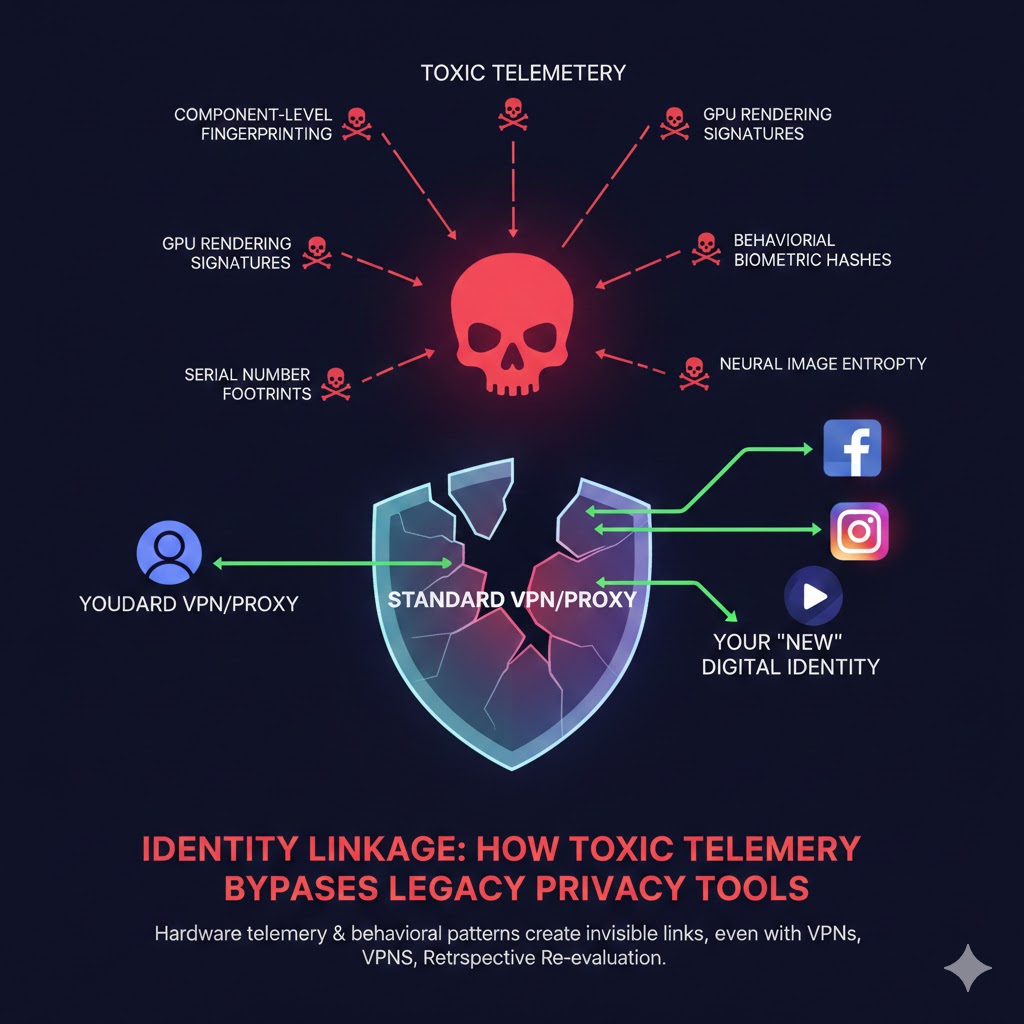
Stop the Cycle of Forensic Termination. Transition to the Protocol 2026 Framework
Glossary
See a free sample from the Handbook
The Evolution of Identity Forensics
The defense perimeters of Tier-1 social ecosystems have undergone a fundamental shift. Traditional methods of maintaining digital presence—such as basic proxy usage or clearing browser cookies—are now obsolete. In 2026, the heuristics utilize Retrospective Re-evaluation to scan years of historical data for a single point of technical convergence.
If your digital architecture is not built from the hardware layer up, it is vulnerable. Protocol 2026 provides the blueprint for building a “Clean-Room” Environment, ensuring your digital assets remain insulated, high-trust, and link-proof.
In 2026, High-Trust Identity Restoration has evolved from a niche recovery service into a critical pillar of “Identity-First” security. As generative AI and deepfake technologies undermine traditional verification, businesses and individuals require more than just password resets; they need a comprehensive framework for reclaiming and re-validating their digital personas.
Establishing the New Perimeter
Identity is no longer just an access point—it is the new security perimeter. High-trust restoration focuses on Identity Resilience, ensuring that when a breach occurs, the path to recovery involves “Continuous Trust Assessment” (CTA). This process moves beyond static biometric checks, which are now vulnerable to synthetic manipulation, and instead utilizes Behavioral Biometrics and network context data. To optimize for this keyword, content must emphasize “Trust Beyond Appearance,” documenting how a system validates movement patterns, typing cadences, and device fingerprinting to confirm a user’s authenticity during the restoration lifecycle.
 Core Pillar 1: Hardware Telemetry and Component Siloing
Modern applications no longer just look at your IP address; they scan for Serial Number Fingerprints and GPU Rendering Signatures. Every mobile device carries a unique mathematical identity that, once flagged, becomes “Toxic.”
Hardware Isolation Protocols
Protocol 2026 details the mandatory shift toward Hardware Siloing. We examine why refurbished devices often carry “Legacy Infection” and how to properly initialize a brand-new device without triggering an Identity Challenge. You will learn to manage:
-
Advertising ID (IDFA/AAID) Resetting: Why OS-level resets are often insufficient.
-
Component-Level Fingerprinting: Neutralizing the detection of internal hardware serials.
-
OS-Level Contamination: Preventing cross-contamination from cloud backups and legacy synchronizations.
Core Pillar 2: Strategic Networking and CGNAT Anonymity
Protocol 2026’s use of CGNAT (Mobile Hotspots) and Hardware Siloing is a significant step above standard consumer privacy tactics, which are increasingly useless against 2026-era AI heuristics.
 Your network connection is your Reputation Anchor. In 2026, the ecosystem utilizes ASN (Autonomous System Number) Intelligence to categorize every node. If your connection originates from a data center or a common commercial VPN, your “Trust Score” is penalized before the session even begins.
The Power of Residential IP Reputation
Protocol 2026 advocates for the Mobile Data “Human Shield.” By utilizing a dedicated 5G hotspot, you enter a CGNAT (Carrier-Grade NAT) environment. This environment provides a layer of collective anonymity, as thousands of users share a single public IP. Tier-1 algorithms are economically disincentivized to blacklist these IPs, providing you with a high-trust residential signal that is essential for Asset Continuity.
Core Pillar 3: Neutralizing Kinetic Biometrics and Behavioral Signatures
The most insidious form of modern tracking is Behavioral Profiling. Trillion-dollar ecosystems now monitor the involuntary physiological rhythms of how you interact with your device.
Kinetic Telemetry Mapping
Every individual has a unique Input Cadence. The milliseconds between your keystrokes (flight time) and the duration of your touch (dwell time) create a Biometric Hash as unique as a fingerprint. Protocol 2026 teaches you how to:
-
Zero-out Accelerometer Jitter: Why using your device on a flat surface is a critical “Anti-Forensic” technique.
-
Disrupt Typing Rhythms: Utilizing third-party haptic overlays and Voice-to-Text to reset your behavioral signature.
-
Mimic High-Value Consumer Patterns: Shifting from a “Content Creator” profile to a “Content Consumer” profile to satisfy internal revenue metrics.
Core Pillar 4: Neural Hashing and Visual Asset Re-Engineering
Tier-1 Social Ecosystems utilize Neural Hashing to identify visual duplicates. Unlike standard file hashing, Neural Hashing creates a “Perceptual Map” of an image. If you upload a creative asset that has been previously restricted, the AI identifies the spatial coordinates of your face or the landscape and initiates a Silent Linkage.
The Triple-Pass Sanitization Method
To maintain Digital Sovereignty, every visual asset must be re-engineered. Protocol 2026 introduces the Triple-Pass Method to destroy mathematical entropy and reset the image’s neural hash:
-
Device-Specific Screenshots: Generating new resolution metadata.
-
Spatial Coordinate Shifting: Utilizing strategic cropping to reset edge-detection coordinates.
-
Entropy Injection: Using 2-3% digital noise to create a fundamentally new perceptual map for the AI.
The 14-Day Nurture Schedule: Engineering Trust Telemetry
The first two weeks of a new identity are the most critical. This is the Stabilization Phase. Protocol 2026 provides a day-by-day interaction ceiling to prevent the “Velocity Trap.”
When a user attempts to rebuild their digital life too quickly, they exhibit “High-Velocity” signals that the AI identifies as automated behavior. By following our Consumer Mimicry Protocol, you establish a Neutral Baseline of “Messy Telemetry.” This signals to the Global Trust Engine that you are a high-value, low-risk resident—a demographic the ecosystem is programmed to protect.
 Why Media Buyers Choose Protocol 2026
In an era of Shadow Bans and Reach Suppression, the professional media buyer cannot afford to be “linked.” Protocol 2026 is the industry-standard manual for those who require:
-
Asset Stability: Keep your Business Managers and Ad Accounts active through platform-wide audits.
-
Identity Resilience: Build personas that survive manual reviews and automated identity challenges.
-
Data Sovereignty: Understand how your data is being tracked and take control of your digital footprint.
-
Forensic Knowledge: Stay ahead of the Advantage+ Security AI by understanding its internal logic.
Frequently Asked Questions about Identity Resilience
What is Digital Identity Resilience?
Digital Identity Resilience is the ability to maintain a stable, high-trust presence across Tier-1 ecosystems without being linked to legacy restricted data. It involves a holistic approach to hardware, networking, and behavioral telemetry.
How does Hardware Siloing work?
Hardware Siloing is the practice of isolating a specific digital identity to a dedicated physical device. This prevents the “Cross-Contamination” of device IDs and component-level serial numbers that AI uses to link multiple profiles to a single user.
What is Neural Hashing in 2026?
Neural Hashing is an AI-driven method of identifying images based on their visual essence rather than their digital code. It allows platforms to recognize “new” photos as being identical to “old, restricted” photos by mapping spatial features and lighting vectors.
Secure Your Digital Future Today
Stop fighting the algorithm and start working with it. By implementing a High-Trust Architecture, you transition from a “Recidivist Risk” to an “Established Resident.”
The Protocol 2026 Framework is available for professional media buyers, privacy engineers, and digital architects who refuse to be defined by their legacy footprint.
Protocol 2026: Identity. Resilience. Sovereignty.
© 2026 Identity Forensics Research Group. All rights reserved. For educational and privacy-research purposes only.
Daily Identity Resilience Intelligence
Status: STABLE | Updated: jan 30, 2026
| Metric | Current Level | Protocol Requirement |
|---|---|---|
| ASN Trust Score | 92% | Optimal for Initializations |
| Neural Hash Sensitivity | 0.84 (High) | Triple-Pass Method Mandatory |